

Last week, USDA announced a “reorganization” of the Food Safety and Inspection Service (FSIS), the agency charged with ensuring the safety of the nation’s meat, poultry and egg products. The Administration will not so much reorganize FSIS as simply relocate much of its staff, in a move that harkens back to the first Trump Administration’s 2019 relocation of USDA’s Economic Research Service (ERS) and National Institute of Food and Agriculture (NIFA), from D.C. to Kansas City, Missouri. Judging from that relocation experience, the new plan will further compromise an agency already struggling to fulfill its consumer protection mission.
According to yesterday’s announcement, “approximately 200 [FSIS] positions will be relocated from Washington D.C,” this time to Urbandale, Iowa; Athens, Georgia, and Fort Collins, Colorado. These positions represent a small fraction of the roughly 7,500 employees within FSIS, most of whom serve as frontline inspectors, but they represent a majority of the leadership staff who figure out how all of those inspectors should spend their time and effort, day after day, in over 7,100 federally inspected establishments. A reduced contingent of FSIS staff, “roughly 100 positions,” will stay in D.C. “to support congressional engagement, policy development and interagency coordination.”
How will the relocation plans affect FSIS? In the short-term, it will likely make the agency much smaller. The graph below shows the Office of Personnel Management’s official employment tally at USDA’s Economic Research Service. USDA announced its plan to move ERS to Kansas City on August 9, 2018.
USDA Economic Research Service Total Employees
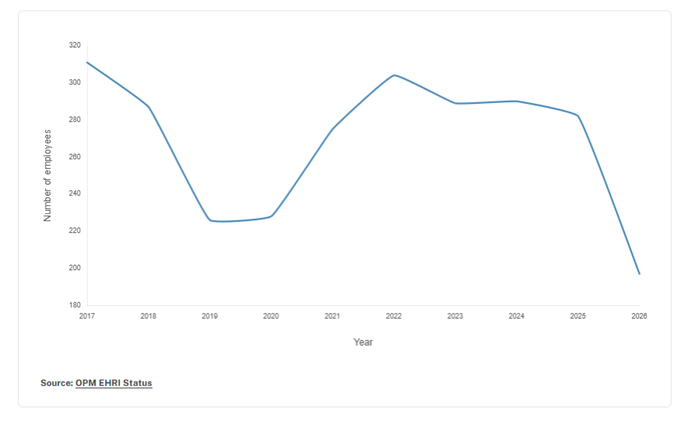
As the graph indicates, the prospect of uprooting their lives and moving to Kansas City led many ERS economists to quit. The exodus of expertise from ERS represents “one of the great tragedies of the Trump Administration,” in the words of Marion Nestle. In 2023, the Government Accountability Office documented a steep decline in the agency’s productivity as a result. Notably, the relocation’s impact appears less dramatic now in comparison with the departures that followed the Department of Government Efficiency’s assault on the federal workforce.
As the graph below shows, DOGE ran off much of the FSIS staff as well. Granted, some of the reductions reflect longer-term initiatives to offload certain inspection tasks onto private employees at meat and poultry processing establishments. But the agency has also gone through a notable churn among civil service leadership. As one headline earlier this year put it “Trump purge at FDA and USDA triggers food safety ‘brain drain’.”
USDA Food Safety and Inspection Service Total Employees
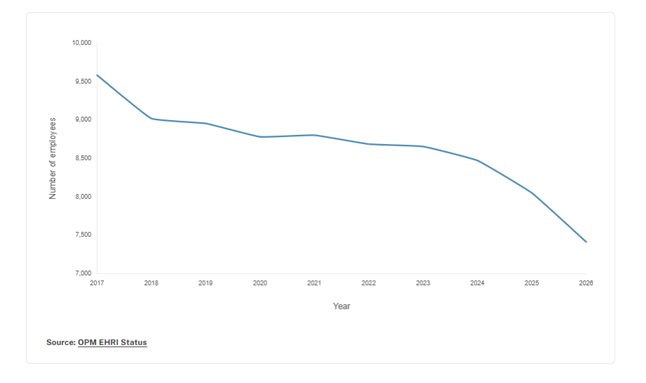
The latest “reorganization” seems likely to open the drain a bit more.
That is bad news for consumers. In all likelihood, further brain drain at FSIS will further delay long overdue reforms on issues like Salmonella. Since 2001, when industry sued to successfully block FSIS from enforcing its Salmonella performance standards, the agency has operated under a fundamentally dysfunctional regulatory scheme. Public health has suffered as a result. Meat and poultry’s contribution to Salmonella illnesses has steadily grown. Chicken alone now accounts for more Salmonella infections each year than any other single food category, with its contribution to illness outbreaks shooting up 84% since 2013, according to Interagency Food Safety Analytics Collaboration (IFSAC). This increase starkly contrasts with the experience in Europe, where Salmonella infections declined over 50% since reforms there targeted dangerous Salmonella serotypes, a “major success story.” Yet when FSIS has moved towards reform, it has met fierce resistance from trade associations like the National Chicken Council.
Under the Biden Administration, FSIS countered this resistance by meticulously assembling a scientific record in support of new, enforceable, product standards for Salmonella in poultry. A proposed rule would have prevented chicken companies from knowingly selling product contaminated with sky-high levels of the most virulent Salmonella (something the current rules allow). FSIS also finalized new standards for a category of frozen, raw chicken products that caused a disproportionate number of salmonellosis outbreaks. But the industry fought back, and convinced the Trump Administration to shelve the new standards.
The current FSIS leader, Under Secretary for Food Safety Mindy Brashears, has said that Salmonella in poultry remains a priority for FSIS, and promoted innovations like biomapping and molecular testing that could very well lead to significant progress in reducing foodborne illnesses. Formulating the rules, standards, inspection protocols, and other incentives that will prompt industry to actually adopt new food safety innovations, however, will not happen by itself.
Left to their own devices, meatpackers will underinvest in food safety. USDA itself has said so. As agency researchers have explained, “plant managers undertake investments only up to the point at which it is no longer profitable for them to do so.” With just 1 in 29 Salmonella illnesses registered, and far fewer attributed to any given product, underinvesting in food safety will be (and has been) “good for business” so long as federal rules fail to give companies proper incentives to make an optimal investment in food safety. Determining that “optimal investment”—the amount where the marginal cost of an investment in food safety equals the marginal reduction in expected foodborne illness harm—requires capable regulators. Time will tell how many of them are willing to pick up stakes and start new lives across the country to continue working at FSIS.