Food Safety and Corruption

As foodborne illness outbreaks have grabbed headlines, confidence in the federal government’s stewardship of the food system has faltered. The Administration has sought to redirect public attention towards the nation’s obesity epidemic, and its promise of getting us all to eat “real food.” But progress on reducing the nation’s chronic diet-related disease epidemic faces the same fundamental problem today in the United States as efforts to prevent acute foodborne illness: rampant corruption.
Nutrition and food safety are not the same, but they overlap significantly. A growing body of evidence suggests that harmful additives in food are a key driver of chronic disease. At the same time, microbiological pathogens like E.coli in romaine lettuce or, more recently, Cyclospora in salad greens, can scare off consumers from more nutritious foods, pushing them to eat more sterile, typically ultra-processed, foods.
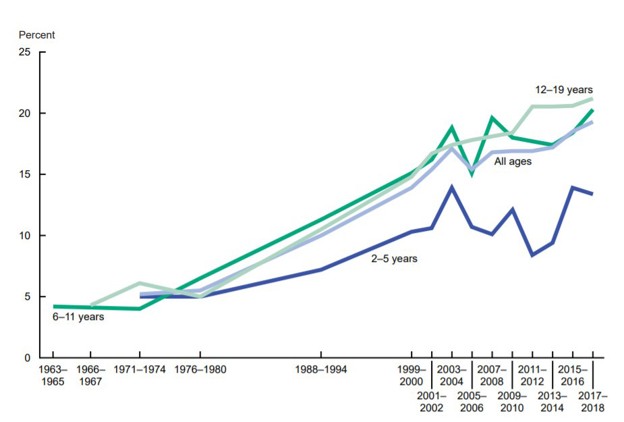
So a strategy to improve Americans’ diets that that neglects microbiological food safety does not make a lot of sense. Even so, policies to rid the food supply of sketchy ingredients and improve consumers’ access to “real food” could do a lot to improve public health. This is not a new problem. As the graph below from the National Institutes of Health shows, child obesity has been soaring for decades:
Trends in Obesity Among Children and Adolescents Ages 2–19 years, by Age: United States, 1963–1965 through 2017–2018
Why has our public health system allowed this to happen?
In a word, corruption. Food is complicated, and throughout history, well-intentioned people and innovations have gone awry. Trans-fat, for example, was long thought to be healthier than the saturated fats it replaced. But corruption explains a lot of why one in five kids today can expect to suffer from obesity before they reach adulthood. All too often, long after the science has revealed an unacceptable health risk associated with a food product (e.g. trans-fat), vested interests have delayed or stymied corrective action. It took 25 years of advocacy by groups like CFA member Center for Science in the Public Interest to get trans-fat out of the food supply. The carcinogenic pig feed additive carbadox offers a contemporary, and galling, example of industry rent-seeking behavior at work. And the same stall tactics have preserved obviously inadequate regulatory processes (e.g. allowing chemical companies to secretly self-determine novel food ingredient safety).
Campaigning as disruptive reformers, the Administration has portrayed its Make America Healthy Again movement as an antidote to Big Food’s corrupting influence. At the recent Republican “mid-term convention,” HHS Secretary Kennedy slammed the Democratic Party for having “cultivated deep ties” with “Big Food.” There is some truth in this. The food and beverage industry reportedly gave $8.08 million to the Democratic Party in the 2024 election cycle. But the same reporting shows the industry gave $9.95 million to the Republican Party. Likewise, the Administration’s “MAHA Report” criticized the Dietary Guidelines for Americans (DGAs) as “being unduly influenced by corporate interests.” Yet when the Administration assembled a group of experts to issue new guidelines, they disclosed financial ties to the National Cattlemen’s Beef Association, the National Dairy Council, and General Mills, among others. Not exactly “pure as the wind driven snow,” as the irascible consumer advocate Tony Corbo used to say.
Not all corruption is the same. A scientist that accepts grant funding from a trade group is not necessarily corrupt, nor is a member of Congress who accepts a campaign donation from a food company. Formally defined, corruption is “dishonest or illegal behavior especially by powerful people (such as government officials or police officers),” or “inducement to wrong by improper or unlawful means (such as bribery).” Money influences people in insidious ways. As Upton Sinclair said, “it is difficult to get a man to understand something, when his salary depends upon his not understanding it.” But in a world of super PACs and public-private partnerships, the line between acceptable conflicts, or appearances of conflict, and corruption, is not always clear.
That ambiguity puts a premium on rigorous and uncompromising responses to powerful people who are caught red-handed engaging in dishonest or illegal behavior. And that is where this Administration and its allies in Congress most distinguish themselves. There are already indications that the new normal will jeopardize food safety.
Take infant formula. Last week, the Department of Justice announced a $385 million civil settlement with Abbott Laboratories. After four babies fed Abbott formula developed cronobacter sakazaki infections, two of whom died, a nationwide infant formula shortage ensued. Notably, then-FDA Commissioner Robert Califf and Abbot executives were grilled by House and Senate panels back in 2022, but a more recent botulism outbreak linked to infant formula, which has put over 50 babies in the hospital, has failed to rouse the 119th Congress to hold a single hearing. In any event, the Abbott civil settlement sounds like a lot, but in the past, the company would have likely faced criminal sanctions. The government alleged that the company “knowingly” failed to adopt safeguards against cronobacter sakazaki contamination in their Sturgis, MI infant formula manufacturing facility, and “withheld information from FDA related to the presence of microorganisms in the Sturgis facility.” Why not enforce the statute’s criminal penalties for this behavior?
As it turns out, DOJ had opened a criminal investigation. But a May 2025 Executive Order announced a new policy that “criminal enforcement of criminal regulatory offenses is disfavored,” and the Trump Administration disbanded the Justice Department unit that handles criminal and civil enforcement of U.S. food and drug safety laws. Foodborne illness litigator Bill Marler recently wrote: “Every food safety executive I have ever deposed has told me some version of the same thing: the budget requests get approved after somebody gets prosecuted, not after somebody gets sick.” In other words, without a credible threat of criminal enforcement, expect companies to invest less in food safety, and more foodborne illness outbreaks.
Investigating those outbreaks may become more complicated too. After investigators linked Taylor Farms lettuce to an unprecedented wave of cyclospora illnesses, FDA did not send a team of investigators to the farms implicated in the outbreak for weeks. Part of this was because Taylor Farms stonewalled on providing location data to FDA for roughly a week—information that would have been required within 24 hours under the final traceability rule scuttled by the Administration. But safety concerns also contributed to the delay. In Guanajuato province, where Taylor Farms grows its lettuce, 2,035 people were murdered last year. The people are terrorized by drug cartels. For its inspectors’ protection, FDA had to coordinate its travel with U.S. State Department security experts.
To be clear, Mexican drug cartels were a problem before the Administration came to power. Moreover, history suggests even the most earnest, expert U.S. federal campaign to combat the cartels may have limited effect. But by abandoning some of the most significant restrictions on money laundering under federal law, the Administration has turned the United States into “a safe space for money launderers, drug cartels, and international financial rogues.” Presidential pardons to drug traffickers and drug money launderers, not to mention a foreign policy that targets judges and regulators on behalf of autocrats and Big Tech, have reinforced the “pay-to-play” message.
Public health does not pay to play. It depends on elected officials honoring their commitments to ordinary voters, exercising restraint in the face of scientific uncertainty, and establishing processes to gather better data and validate whether policies are working. Will Administration officials like Heidi Overton, the nominee for FDA Commissioner who recently spoke out in favor of cutting back the national childhood vaccination schedule, take this sort of approach to champion policies at odds with the interests of Big Food? The Administration’s food safety record so far—from eliminating six of eight pathogens tracked by CDC’s FoodNet surveillance system, to delaying enforcement of FDA’s traceability rule for two-and-a-half years, to disbanding USDA’s food safety advisory committees—suggests otherwise. Hopeful food reformers should take notice and beware.