Revising Myths about the Federal Home Loan Banks: A Close Look at Two Recent Studies on the Links Between Advance Lending and Housing Activity
Earlier this year, the Urban Institute published a report on the Federal Home Loan Bank (FHLBank) System. The Council of Federal Home Loan Banks funded the study, which found that increases in advance lending to member banks were associated with substantial increases in real estate lending. This finding is in contrast with what the Government Accountability Office (GAO), an independent arm of Congress, found in a study published just a month prior which examined the same relationship and found a much smaller impact for member banks (and no impact for large members). How could the GAO find such a weak (or non-existent) relationship between FHLBank advance borrowing and real estate lending compared to Urban?
This blog walks through the methodological choices behind each study in plain English and explains why their conclusions diverge. We argue that the GAO’s estimates offer a more reliable guide for policymakers. Here’s why.
Note: Although both studies are highly technical, the analysis presented here is accessible to those with a non-technical background. For technical readers, the Appendix below dives deeper into the methodological details.
What Is the Federal Home Loan Bank System?
The Federal Home Loan Bank (FHLBank) System is a government-sponsored enterprise (GSE) whose function is to extend credit to member institutions, who in turn provide liquidity for housing finance. It does so by using the implicit government guarantee that accompanies its GSE status to provide low-cost advances (loans backed by collateral) to banks, insurance companies, credit unions, and community development financial institutions (CDFIs). GSE status exempts the FHLBanks from some regulatory requirements as well as having to pay income taxes. The Congressional Budget Office estimates that taxpayers subsidize the FHLBanks by approximately $7.3 billion per year. The question is whether this money goes to helping people afford housing or subsidizing profits for financial companies and excessive FHLBank executive compensation.
What Do the Two Studies Find?
The Urban Institute and the GAO both attempt to measure whether the advances from FHLBanks to their members correlate with greater lending activities. FHLBank advances range from overnight loans to 30-year borrowings. Institutions receiving these advances have no obligation to use them toward housing finance — in fact, 42 percent of member institutions (including insurance companies and many banks) have not even originated a single mortgage over the last five years. One might think that if almost half of FHLBank members who get advances don’t originate mortgages, how can advances support housing? Member institutions instead often use advances as a day-to-day liquidity management tool or to reinvest in higher-yielding assets as a profit-boosting strategy. These studies do not and cannot measure where advance dollars go directly; they instead analyze the relationship through statistical modeling.
The primary purpose of the GAO’s study was to investigate FHLBank lending to banks during periods of financial stress following the implosion of Silicon Valley Bank in 2023, but it also evaluated whether FHLBank advances were correlated with increased lending. For small banks ($10 billion or less in total assets), GAO found that a one percent increase in advances from one quarter to the next was associated with a 0.003 percent increase in residential lending from 2015 to 2024. While it may be statistically significant, this effect is pretty close to zero. Even if a small bank doubles its advance borrowing from the FHLBanks, GAO’s model predicts that their real estate lending would increase by less than one percent.1
For medium and large banks (with more than $10 billion in assets), GAO found no relationship between advance borrowing and real estate lending. While comprising only three percent of the bank members of the FHLBank System, these bank members receive nearly three-quarters (74 percent) of FHLBank advances to bank members. Thus, the vast majority of advance borrowing is not associated with any increase in real estate lending.2
The second study was conducted by the Urban Institute, funded by the Council of Federal Home Loan Banks. This study found that every $100 increase in FHLBank advances (relative to assets) by banks is associated with an $18 increase in real estate holdings (over assets): a relationship much stronger than the near-zero result found in the GAO study!3
The Urban Institute study’s authors aggregated these effects to calculate an overall impact of $811 billion in increased real estate lending over the study period (2002-2024). While the study does not claim to find a causal relationship, its findings have already been used out of context by the Council of FHLBanks to lobby the Federal Housing Finance Agency and Congress against reforming the FHLBank System.
The next sections investigate why these studies diverge in their findings and draw insights from both studies to offer a more accurate picture of the role of FHLBank advances in housing finance. It highlights two major methodological issues with the Urban Institute report and points to the GAO study as a more accurate measure of the relationship between FHLBank advances and real estate lending: a relationship that is modest overall and non-existent for the FHLBanks’ biggest member borrowers. These findings demonstrate how the FHLBank System has strayed from its housing mission.
Issue 1: Which Members Actually Use FHLBank Advances?
To understand the potential housing impact of any advance dollar lent by the FHLBanks, it is important to understand which members actually borrow the bulk of FHLBank advances. This offers important context for the GAO and Urban Institute studies.
Figure 1: Member Borrowing of FHLBank Advances in 2025
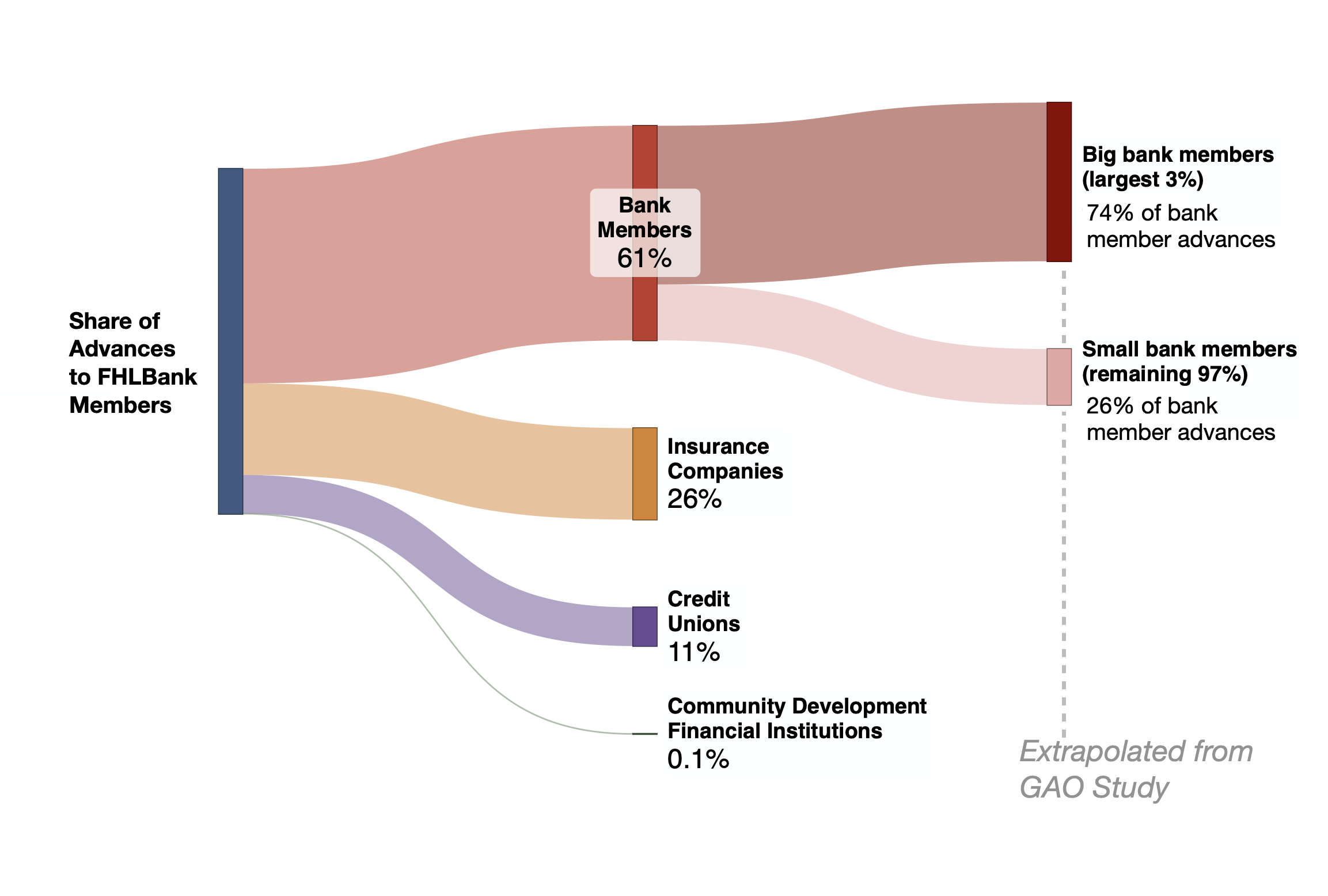
Sources: 2025 FHLBank Annual Report, Government Accountability Office.
Notes: Percentages do not round to 100 percent because figures are rounded and exclude advances to non-members. Made using SankeyMATIC
Figure 1 above shows who borrowed the $670 billion in FHLBank advances to members in 2025. Among bank member borrowers, an outsized portion of advances went to the nation’s biggest Wall Street banks: nearly three-fourths of bank member advances (74 percent) went solely to the biggest three percent of bank members (those with more than $10 billion in assets). The GAO and Urban Institute studies differ strongly in how they account for this disparity, which goes a long way in explaining their different findings.
The GAO runs a separate analysis for big banks in its study, finding no relationship between FHLBank advance lending and residential real estate lending activities for these institutions — meaning that big banks don’t do more housing lending based on how much FHLBank advances they borrow.
In contrast, the Urban Institute study does not appropriately account for bank size, meaning their analysis pools both big banks and small banks together and counts them equally (by “weighing” advance dollars by the total assets of each bank, see the Appendix for a technical discussion). For example, take America’s largest and smallest banks – think JPMorganChase versus Kentland Federal Savings and Loan Association. If JPMorgan Chase’s advances led to zero additional housing loans (as the GAO concluded) and Kentland Federal Savings’ advances were associated with a 20 percent increase, the Urban Institute methodology would average these to 10 percent and apply that number to the billions in JPMorgan Chase’s borrowing from the FHLBanks. This is absurd as Kentland is a bank with $3,730,000 in assets and JPMC is a bank with $5,000,000,000,000 in assets (put another way, Kentland is 0.000000746 the size of JPMC).
Not appropriately accounting for bank size results in overstating the power of advance dollars, neglecting the fact that the biggest share of the pie goes to some of the nation’s most affluent banks. It would be like splitting New York City into two groups of people: players on the Knicks and everyone else. To calculate the average height of male New Yorkers, Urban’s methodology would take the average height of the Knicks (6’ 6”) and the average height of all other men (5’ 10”) and then conclude the average height for the entire city was 6’ 2”. The GAO’s conclusions are more accurate as they separate the impacts of FHLBank advance dollars for different types of banks.
Figure 1 also shows both the Urban Institute and GAO studies neglected to measure the second-biggest borrower of FHLBank advance dollars: insurance companies. As of 2025, insurance companies held one quarter (26 percent) of all outstanding advances ($178 billion). To put this into perspective, FHLBank borrowing by insurance firms was more than twice that of all credit unions and Community Development Financial Institutions (CDFIs) combined.
Insurance companies have taken a growing share of FHLBank advances in recent years, using access to low-cost advances as part of their investment strategies. Private equity firms have acquired these insurance companies to gain access to massive amounts of cheap FHLBank loans, investing these for profit. For instance, the insurance company Athene, held by the private equity firm Apollo Global Management, borrowed the second-highest amount of advances of any borrower from the FHLBank System in 2025 ($23 billion). Rather than supporting housing, these funds went toward Apollo’s “investment spread strategy” as per its own disclosures in 2025. The recent federal investigations of Dodgers owner Mark Walter have also put the spotlight on private-equity-owned insurers and their risky strategies: his insurance companies’ borrowings from the FHLBank of Indianapolis almost doubled since 2024, reaching $6 billion by mid-2026.
Leaving insurance companies out of estimates of how FHLBank advances impact housing is problematic, as insurance companies do not make any mortgage loans. Insurers’ limited relationship to housing is through investments in Mortgage Backed Securities (MBS) and small shares of real estate loan holdings. But given that MBS is already one of the most liquid, global markets, with over $11 trillion of securities outstanding, insurers’ relatively minor investments do not lower mortgage or housing costs.
By definition, this means that both the GAO and Urban studies overstate the relationship between FHLBank advances and real estate lending by only looking at banks and depository institutions: both leave out the $178 billion that insurance firms borrowed in advances in 2025. Like with the Urban Institute findings, if GAO were to rerun their analysis to include insurance companies, the muted effects of FHLBank advances would certainly decrease even further, if not totally disappear.
Issue #2: An Artificially Inflated Measure of Total Impact
The Urban Institute’s most emphatic finding is that, from 2002 to 2024, increases in advances contributed to increased real estate lending of $811 billion.
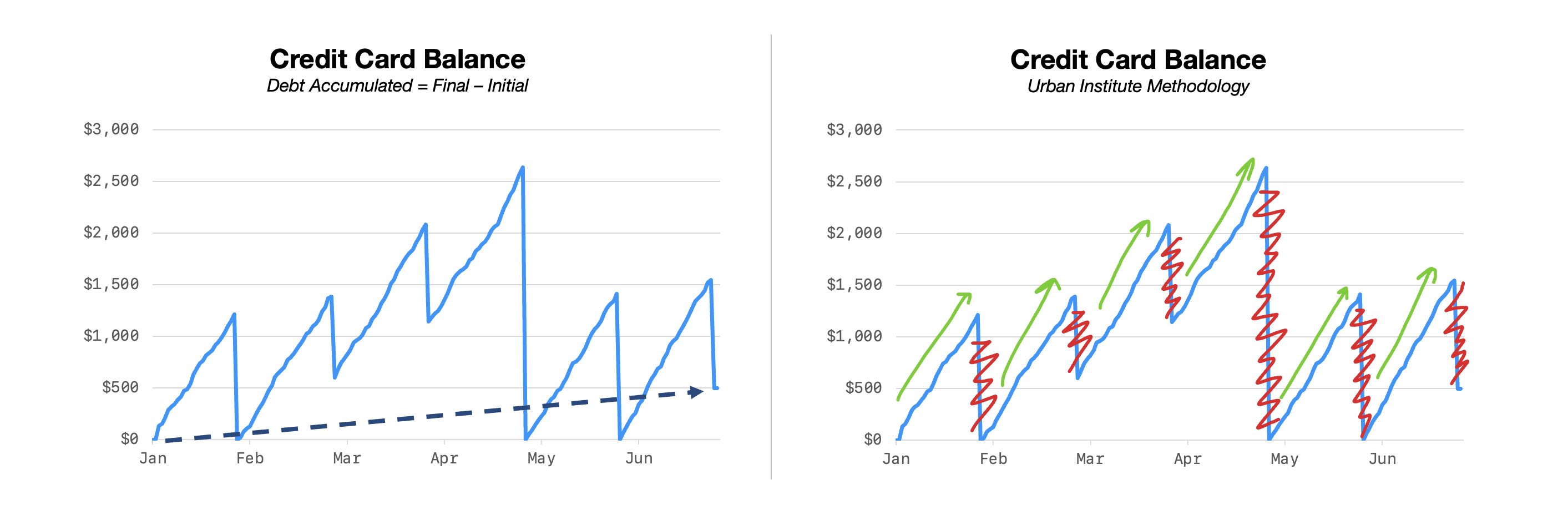
This finding is based on a flawed method for adding up “advance increases” that inflates the FHLBanks’ actual role. Why is this number wrong? Because it miscounts advances: adding up only increases of advances over time, without considering that banks use FHLBank advances more like a revolving line of credit, with borrowings going up and down as they pay them back.
Consider the example of credit card debt. If a consumer has a credit card that they pay off in part each month, the balance on their credit card goes up in varying amounts as they make purchases, before decreasing when they pay some of the debt (plus fees and interest). This situation is analogous to a member borrowing advances from the FHLBanks. The example in the first panel of Figure 2 considers a person who runs their credit card up and down over six months, sometimes paying it all off and sometimes carrying a balance. How much debt they accumulated over six months is easy: the final balance ($500) minus the initial balance ($0).
Figure 2: Measuring How Much Advances “Increased”
Source: Consumer Federation of America
Urban’s methodology, though, counts when balances went up but ignores when debt was paid back. As the second panel of Figure 2 shows, applying Urban’s approach to the credit card example gives an answer of more than $10,000 in debt, which is incorrect. In the same way, the Urban Institute study adds up advances for all the quarters that bank members saw a growth in advance balances while ignoring quarters when advance balances decreased – yielding an artificially inflated number.
The study then multiplies this incorrect advance total with a number (coefficient) derived from an earlier regression model that measured the association between advance dollars and lending activity. However, it overlooks that this model looked at the association between advances and real estate lending in quarters in which debt went up and down, not just up.
There is a reason that the GAO study did not attempt to come up with a similar number: it doesn’t make sense. Unfortunately, the Urban Institute’s attempt creates a convenient myth for the Council for Federal Home Loan Banks to use in their lobbying.
Finally, while the Urban Institute doesn’t explicitly use the word “cause”, the Federal Home Loan Banks have already used their findings to imply a causal relationship where only a correlation exists. But of course, missing factors may explain both changes in advance lending and banks’ real estate holdings over time. For example, while Urban’s study controlled for variations across years (so-called “year fixed effects”) they did not control for more fine-grained macro-economic conditions (such as quarter-to-quarter variations in the unemployment rate and interest rate environment), unlike the GAO study. These time-varying economic factors can shape both how much advance lending the banks demand any given quarter and how much residential real estate loans they hold or originate. Both the GAO and Urban Institute models can only suggest ways that advance dollars and banks’ lending activities may be rising (and falling) together.
Conclusion: Restoring the Housing Mission of the FHLBanks
CFA’s review of two recent studies on the FHLBanks points to the GAO study as a more authoritative source. The FHLBanks have freely used the Urban Institute’s large aggregate number in their lobbying, presenting it out of context as the “annual economic impact” of the FHLBank System.
However, CFA’s thorough analysis demonstrates that advance dollars do not support housing activity as much as the FHLBanks have claimed. The GAO study found no relationship between advance borrowing and real estate lending for the FHLBanks’ biggest borrowers (medium and large banks), and a close to zero relationship for small banks. Both studies also excluded insurance companies – including a growing number of private-equity-owned insurance members – even though they now borrow over a quarter (26 percent) of all advance dollars.
These findings are important for policymakers to understand how the FHLBank System today fails to contribute to its housing mission. Amid today’s housing crisis, the government-sponsored FHLBank system is severely underleveraged and misused: Congressional and regulatory reforms would help redirect billions to housing needs, all without requiring additional taxpayer dollars.
CFA has been a key voice advocating for ways to reform the FHLBanks to do more for housing, including by leading the national Coalition for FHLBank Reform. In 2026, CFA is publishing a series of blogs on the Federal Home Loan Bank System, including to debunk common misconceptions, share the latest financial numbers, and highlight how this trillion-dollar government-sponsored enterprise can do more to tackle the US housing crisis. Previous blogs in this series are:
Private Equity is Gobbling Up Subsidized Housing Loans: Consumers and Workers Beware
Unlocking Billions for Housing: Why Congress Should Reform the Federal Home Loan Bank System
[1] A 100 percent quarter-over-quarter increase in advances is significantly associated with just a 0.3 percent increase in residential loans, according to the GAO’s modeling.
[2] GAO’s model for large banks included 5,175 observations (of bank-quarters). Researchers consider this a robust sample size and adequately powered to find a meaningful and strong relationship, if one existed.
[3] The GAO and Urban Institute estimates are expressed in different units and cannot be directly compared. Since the GAO’s estimate is an elasticity, the exact dollar association depends on the level of advances and real estate lending. We constructed multiple scenarios varying banks by typical asset size, advances, and real estate lending. In each, the resulting dollar association was substantially less than Urban’s $18 estimate. See the Appendix for more details.