The First Congressional Hearing on the Federal Home Loan Banks in 15 Years: A Taxpayer-Subsidized Housing System Gone Astray

The Federal Home Loan Bank (FHLBank) System is the third-largest government-sponsored enterprise – after Fannie Mae and Freddie Mac – yet it has mostly escaped public scrutiny. Most taxpayers have never even heard of this system, which Congress first established in 1932 to help provide affordable liquidity for housing finance and boost homeownership.
On Tuesday July 21, the House Financial Services subcommittee on Housing and Insurance will hold the first Congressional hearing focused on the Federal Home Loan Banks in fifteen years: the last dedicated hearing took place in 2011.
CFA analyzed the System’s 2025 Combined Financial Report and found a troubling picture of the FHLBanks’ priorities, membership, and executive pay. This housing finance system, which the Congressional Budget Office estimates receives an indirect taxpayer subsidy of $7.3 billion each year, has failed to leverage its trillion-dollar balance sheet to spur housing production, lower mortgage costs, or support housing investments by small lenders. Instead of fulfilling its Congressionally chartered mission of supporting housing and community development, the System has increasingly prioritized private profits at the expense of U.S. communities and consumers.
I. Insurance Companies and Large Banks Capture the Greatest Benefits
The main activity of the FHLBanks is to provide low-cost collateralized loans (called “advances”) to its member institutions. Because of the System’s status as a government-sponsored enterprise (GSE), FHLBanks can borrow on capital markets at near-Treasury rates and receive the same credit rating as the U.S. government. The FHLBanks pass on most of this subsidy to members in the form of below-market borrowing costs and generous dividends. In theory, these advances are intended to boost lending activity related to housing and community development. In practice, however, the connection between advance lending and actual housing activity has become increasingly tenuous.
Many of its bank borrowers do not even originate mortgages anymore. A 2023 Bloomberg investigation found that 42% of FHLBank members had not originated one single mortgage in the last five years. What is more, the vast majority of advance dollars go to insurance companies and the FHLBanks’ largest bank members (those with > $10B in assets), even though independent GAO research has found no relationship between their advance borrowing and residential real estate lending.
Insurance companies only remain eligible to be FHLBank members because of outdated membership legislation. When Congress created the FHLBank System in the 1930s, insurance companies were still engaged in home mortgage lending, something that ended in the second half of the twentieth century. Today, the biggest insurance company borrowers are life insurance companies, including several owned by private equity companies, that have virtually no connection to housing finance.
The latest numbers illustrate this shift. The total amount of advances declined from $737 billion in 2024 to $677 billion in 2025 due to lower borrowing from banks, but the share of FHLBank lending to insurance companies increased.
Figure 1: Advance Dollar Lending by Type of FHLBank Members
|
Type |
2024 |
2025 |
|
Commercial banks |
51% |
50% |
|
Insurance companies |
22% |
26% |
|
Savings institutions |
13% |
11% |
|
Credit unions |
12% |
11% |
|
Community Development Financial Institutions (CDFIs) |
0.1% |
0.1% |
|
Housing associates |
0.1% |
0.1% |
Source: FHLBank System 2025 Annual Report
Note: Percentages do not round to 100 percent because numbers are rounded and exclude advances to former members.
Insurance companies accounted for 22 percent of advance borrowing in 2024, a share that grew to 26 percent in 2025. This means that insurance companies borrowed more than twice as much as all credit unions, CDFIs, and housing associates combined: a sobering testimony to the System’s priorities in practice. A recent Government Accountability Office study (p. 15) also found that insurance companies borrowed more than all small banks combined. The same study found that 74 percent of bank advance borrowing went to the largest 3 percent of banks in 2025.
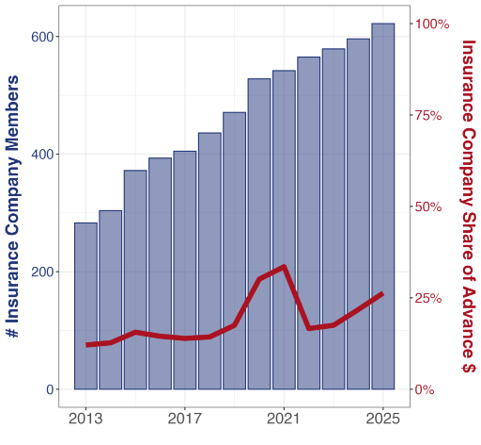
This represents a continuation of a long-standing trend. Figure 2 shows the dramatic growth in insurance company membership and advance lending since 2013. The number of insurance company members more than doubled, from 283 in 2013, to 622 in 2025. Advance borrowing by insurance companies also increased steadily over this period: a trend that temporarily accelerated during the pandemic when demand for short-term advances from large commercial banks plummeted (p. 50 of the 2020 Annual Report).
Figure 2: Trends in Insurance Company Membership and Advance Lending (2013-2025)
Source: CFA Analysis of FHLBanks Annual Reports 2013-2025.
Insurance companies increasingly use the FHLBanks’ taxpayer-subsidized advances to pursue “yield enhancement” strategies: they borrow at subsidized rates, invest them in higher-yielding assets, and pocket the difference to boost their profits. Even in their own marketing materials to insurance companies, the FHLBanks have put this profit strategy front and center. This trend represents a grave departure from the FHLBanks’ Congressionally chartered mission and a misallocation of taxpayer subsidies meant for housing.
II. Excessive Executive Compensation Despite a Simple Business Model
Executive compensation also continued to climb in 2025, according to the FHLBanks’ Annual Reports and public 10-K filings, an issue that CFA also raised with House Financial Services Committee leadership last year.
Figure 3: CEO, Executive, and Total Compensation at the FHLBanks (2025)
|
In 2025 |
|
|
Average CEO pay |
$2,433,415 |
|
Total executives making >$1M |
39 |
|
Total CEO pay |
$36,501,218 |
|
Total executive compensation |
$90,513,280 |
|
Total compensation and benefits |
$887,000,000 |
Source: 10-K Filings for the 11 FHLBanks (2020-2025) and Annual Reports (for Office of Finance and for “total compensation and benefits”). Detailed compensation table available upon request.
In 2025, the average FHLBank President made $2.4 million, while total CEO pay across the System reached $36.5 million. One striking example is the retiring President of the FHLBank of Indianapolis, who not only received $5 million in pay in 2025, but also took home an additional $31.7 million in pension benefits (p. S-30 of Annual Report) — a fringe benefit not even included in the compensation totals above.
The FHLBanks maintain that their compensation practices are consistent with “market standards” and rely on consultants to justify executive pay (p. 140 of Indianapolis 10-K). However, their main peer group has been the similarly inflated fellow Federal Home Loan Banks, followed by much more complex commercial banks. These commercial banks typically have many lines of operations, hundreds of locations, and hundreds of thousands, if not millions of clients. By contrast, most FHLBanks operate from a single office and manage a straightforward business model focused on advance lending and investment portfolio management. Unlike private financial institutions, the FHLBank System also has a unique responsibility towards the public as a Congressionally chartered government-sponsored enterprise that benefits from over $7 billion in indirect taxpayer subsidies each year.
Perhaps the clearest example of the disconnect between the System’s housing mission and its compensation practices is that, in 2025, the FHLBanks spent more on compensation and benefits than they did on the Congressionally mandated Affordable Housing Programs (AHP). Under the Financial Institutions Reform, Recovery, and Enforcement Act of 1989 (FIRREA), each FHLBank must contribute at least 10 percent of its annual net income to the AHP. In 2025, statutory AHP assessments totaled $632 million across the System. By comparison, the System spent $887 million on employee salaries and benefits.
III. Congressional Recommendations for FHLB System Reform
1. Limit insurance company membership or tighten collateral requirements.
The FHLBank System was created to provide affordable liquidity for housing finance and should not be used as a “yield enhancement” investment tool for insurance companies. Congress should limit insurance company membership of the FHLBanks, especially for insurance companies owned by private equity companies. Alternatively, lawmakers should strengthen the residential real estate collateral requirements — assets that member institutions must pledge in order to receive loans. Especially in the case of non-mortgage originating institutions such as insurance companies, the connection to housing finance becomes tenuous when they can leverage already highly-liquid Mortgage Backed Securities (MBS) to gain access to subsidized FHLBank loans. Restricting collateral options for insurance companies to housing assets such as whole mortgages and municipal bonds only, would be another way to help refocus the FHLBanks on mission.
2. Tie executive compensation to mission performance.
Congress should pass legislation that ties executive compensation at the FHLBanks to mission performance and explicitly authorize FHFA to establish reasonable limits on executive compensation. Previously, FHFA itself has pointed to the illogic of setting FHLBank executive compensation levels at those of similarly-sized commercial banks and called for the implementation of mission-related executive compensation standards (p. 66-67). Two Senate bills have been introduced recently that seek to grant FHFA the explicit authority to set executive compensation levels: S. 1439 “FHLB Mission Achievement Act” and the bipartisan S. 1990 “Curtailing Unreasonable Remuneration at Banks Act (CURB).”
3. Increase Affordable Housing Program (AHP) contributions to 30 percent of net income.
Housing advocates have long urged Congress to increase the minimum Affordable Housing Program contributions from 10 percent to 30 percent of annual net income. The FHLBank System successfully sustained a combined 30 percent annual deduction from its profits from 1989 to 2011, when it contributed 20 percent of net income each year to pay off REFCORP obligations in addition to its 10 percent AHP contribution. Since those obligations ended, the System has steadily added billions of dollars to its retained earnings: retained earnings reached a record level of $33 billion in 2025, up from $8 billion in 2011. Raising the statutory AHP contribution to 30 percent would direct more than $1 billion each year to affordable housing, all without compromising the safety and soundness or requiring additional taxpayer funding.
Although most Americans have never heard of the FHLBanks, this System benefits from billions of dollars of public subsidies while severely underdelivering on its housing mission: all in the middle of the worst housing affordability crisis in decades. This week’s House Financial Services hearing is an important first step towards Congressional oversight, but meaningful reform will ultimately require legislation.
CFA has been a key voice advocating for ways to reform the FHLBanks to do more for housing, including by leading the national Coalition for FHLBank Reform. In 2026 CFA has published a series of blogs on the Federal Home Loan Bank System. Previous blogs in this series are:
Private Equity is Gobbling Up Subsidized Housing Loans: Consumers and Workers Beware
Unlocking Billions for Housing: Why Congress Should Reform the Federal Home Loan Bank System