Redlined
The Persistence of Racial Inequality in the Cost of Homeowners Insurance
Over the last few years, rising insurance premiums have strained household budgets. Previous research from the Consumer Federation of America (CFA) found that the cost of homeowners insurance for the typical homeowner rose by 24 percent nationwide from 2021 to 2024. Amid a broader housing affordability crisis, homeowners insurance makes up a growing share of monthly housing costs and increasingly determines who can afford to become - or stay - a homeowner.
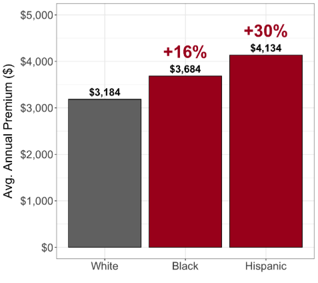
However, the high cost of homeowners insurance does not impact all communities equally. This report finds that homeowners in predominantly Black and Hispanic ZIP codes are charged significantly more for the same homeowners insurance coverage than homeowners living in predominantly white ZIP codes. Comparing the price of identical policies across ZIP codes, this report finds that, on average, homeowners in Hispanic communities pay a 30 percent higher premium (or $950 more per year), while homeowners in Black communities pay a 16 percent higher premium ($500 more per year), compared to what homeowners in white communities typically pay for the same level of protection. Over thirty years of a mortgage, this adds up to at least $28,500 in additional insurance costs for homeowners in Hispanic communities and $15,000 more for homeowners in Black communities. This report calls this considerable upcharge for homeowners in Black and Hispanic communities “the racial premium gap” in homeowners insurance.