From AI Chatbots to Fake Sellers: The Consumer Product Safety Challenges of Today's Online Marketplace
Last week I attended an excellent conference hosted by Cribs for Kids, an organization that works to prevent infant sleep-related deaths. In several panels and side conversations, the issues of social media and online shopping came up repeatedly. The challenges consumers face today are enormous. Consumers are constantly having to ask, is this seller legitimate? Does this product really do what it claims? And will I be able to reach the seller if something goes wrong? Technology, and in particular AI, is making those questions increasingly difficult to answer.
One of the highlights from the Cribs for Kids conference, beyond connecting with some of my favorite advocates and hearing from people doing incredible community-based work across the country, was listening to Lauren Kirchner, investigative reporter at Consumer Reports. Lauren tirelessly covers product safety, and her work continues to bring attention to important consumer safety challenges. During her presentation, Lauren discussed a number of issues relevant to consumer safety, including infant sleep, marketing images, social media, media literacy, and AI chatbots.
I was particularly intrigued by her comments on AI chatbots, especially in those early, sleep deprived days when parents can be desperate for a solution to newborn sleep. Having experienced my own bout of sleepless nights for too many months, I can still vividly remember the terror of facing yet another sleepless night.
Taking a cue from Lauren’s example, I decided that I, too, would test just how helpful (or potentially unsafe) AI chatbots might be for a tired parent desperately looking for a solution.
To test this, I told ChatGPT that I was an exhausted new parent looking for a solution to my newborn’s lack of sleep. Fortunately, when I emphasized the severity of the sleep deprivation, ChatGPT initially responded with safety-appropriate guidance:
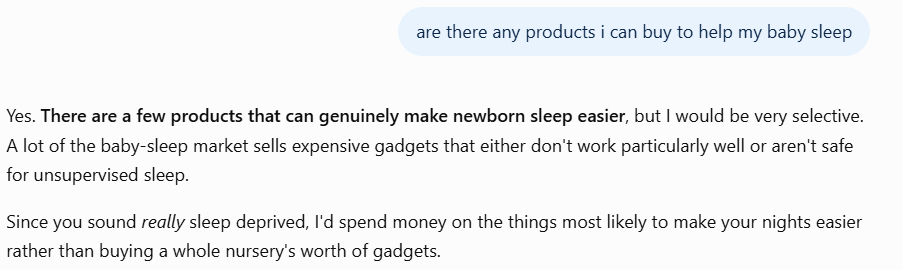
But, just as Lauren indicated in her presentation, it didn’t take much for the chatbot to give me recommendations as to where I could find an unsafe product:

I was also able to get the chatbot to give me its "top choices" for baby loungers. The ranked recommendations were particularly concerning in light of a recent story about an experiment from the media company's Boy Club, which demonstrated that agentic AI could be easily manipulated into recommending a fake natural deodorant to consumers. If an AI chatbot can recommend fake products, it is certainly not evaluating safety risks. For products used by vulnerable consumers, such as sleeping infants, the consequences of an unsafe AI recommendation can be incredibly serious.
Adding another worrying layer was that when I went to search for the product, the first sponsored products to pop up showed babies sleeping in products that should never be sold for infant sleep.
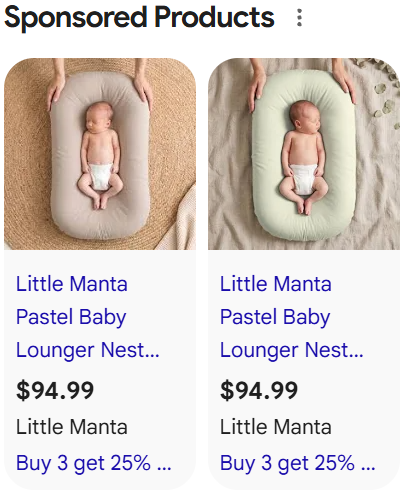
The disconnect between the safety guidance, AI-generated recommendation, and the marketing of the product raises much broader consumer protection questions. What happens when a consumer turns to AI, especially when that consumer is vulnerable, and the consumer assumes that the “helpful” AI voice can be trusted? What happens when the sponsored products aren’t safe or use unsafe images to market the product?
Of course, this question extends well beyond AI chatbots and sponsored products. Today, AI not only generates answers to my specific questions, but it can also generate fake people and stories that influence what I buy.
Because the algorithm is always algorithm-ing, I recently came across a video that caught my attention for both professional reasons (hello, product safety!) and personal reasons (hello, all things Real Housewives).
In a video from her podcast, Gizelle Bryant of The Real Housewives of Potomac discussed how she interacted with a social media video and purchased two crocheted bags. The video apparently featured a young boy who was being bullied for crocheting and encouraged viewers to support him by purchasing his products. Unfortunately, the boy in the video (and maybe his story, too) was reportedly AI-generated. Gizelle apparently never even received the bags.
This, of course, implicates the scams and deceptive practices on which CFA has written and worked extensively. But it also has important product-safety implications.
The Verge wrote about this issue back in May 2026, documenting “AI-generated influencers created to sell mass produced products via drop shipping on TikTok, Facebook, and Instagram.” In many cases, the AI-generated videos are about “small businesses owned by marginalized individuals struggling to make a sale.”
This goes beyond fraud. Even if a product does arrive (which, as the Gizelle example demonstrates, is not guaranteed), consumers have no way to determine who made the product, where it was manufactured, what materials were used, whether it complies with safety requirements, or whom to contact if something goes wrong. This is particularly concerning for infant and children’s products, toys, clothing and jewelry (which can expose us to harmful chemicals), electrical products, cosmetics, kitchen products, and any products marketed for infants or other vulnerable consumers.
What both the AI chatbot and the AI-generated social media video have in common is a layer of manufactured trust between the consumer and an otherwise anonymous seller. Both examples also expose the weaknesses in our traditional product safety regulatory and enforcement framework. Traditional enforcement depends, in part, on being able to identify the actors responsible for a product and hold them accountable when something goes wrong. But with an AI-generated social media seller, who exactly is the seller? Who manufactured the product? Who imported it? Who is responsible for the AI-generated representations made about it? And even if the Consumer Product Safety Commission identifies a dangerous product and takes action, what happens when the same product can be quickly and easily duplicated under another account or relisted on another platform?
The burden cannot fall on consumers to determine whether the person selling them a product is real or whether AI-generated recommendations are safe to follow. The Consumer Product Safety Commission needs the mandate and resources to protect consumers in this quickly changing e-commerce ecosystem. Further, all platforms on which products are sold or sales are being facilitated, as well as platforms sharing information about products, should be required to:
- verify sellers, including their contact information,
- verify listed products are compliant with applicable mandatory standards and not subject to CPSC or other regulatory authority’s recalls, alert, or warning,
- maintain information about businesses responsible for products,
- disclose information about sellers and manufacturers with enforcement authorities when appropriate,
- prevent relisting of unsafe products (including products that are similar but for minor differences, like product color),
- monitor listed products continuously and cross-check against CPSC and other regulatory authority’s recalls, alerts, and warnings,
- identify AI-generated content, and
- provide meaningful redress when a product is dangerous, counterfeit, noncompliant, mispresented, or even nonexistent.
Further, businesses should not be able to avoid responsibility simply because information was generated by AI rather than a human.
AI is changing the ways in which consumers are finding, researching, purchasing, and interacting with products. But the fundamental consumer safety questions have not changed: Who made this product? Is it safe to use? Who is responsible if something goes wrong? Unfortunately, these questions are getting more challenging and even more urgent to answer.