Off-Highway, High Consequences: Children and Families Continue to Pay the Price

Hundreds of Americans continue to die every year in off-highway vehicle (OHV) fatalities. According to Consumer Federation of America’s (CFA) most recent data, 583 riders lost their lives in preventable OHV accidents across the country in 2025. Children accounted for a disproportionate share of OHV-related fatalities. Among these preventable deaths, children aged 15 years or younger represented the largest group, accounting for 108 fatalities. Another 48 deaths involved adolescents between the ages of 16 and 19. Altogether, individuals aged 19 years and younger accounted for 27 percent of all OHV-related fatalities.
“The number of children killed year after year by off-highway vehicle is a terrible indictment of our product safety system” said Courtney Griffin, CFA’s Director of Consumer Product Safety. “It is unacceptable that hundreds of children have died from preventable off-highway vehicles tragedies, while nothing changes and no meaningful safety reform occurs. These statistics are not just numbers. They are young lives cut too short and deaths that leave permanent scars on families and entire communities. We must do more to protect our most vulnerable.”
“All OHVs, even youth models, pose risks,” said Dr. Gary Smith, President of the Child Injury Prevention Alliance. “OHVs are fast, complex machines, and due to their design, they roll over easily. One wrong choice could lead to the emergency department or worse. Children younger than 16 years just aren’t ready for the demands of safe riding, so we encourage parents to find a different activity for their child.”
Publicly Available OHV Fatality Data is Lacking
Comprehensive and publicly available statistics on OHV fatalities are lacking. In April 2026, the Consumer Product Safety Commission (CPSC) released its report Consumer Product-Related Injuries and Deaths in the United States: Estimated Injuries Occurring in 2024 and Estimated Deaths Occurring in 2023. The report demonstrates that off-road vehicles remain a significant source of deaths and injuries in the United States. The report estimates 1,360 consumer product-related deaths associated with off-road vehicles in 2023.
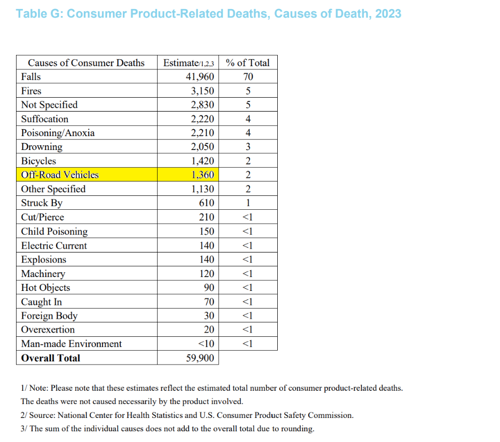
Source: U.S. CPSC, Consumer Product-Related Injuries and Deaths in the United States: Estimated Injuries Occurring in 2024 and Estimated Deaths Occurring in 2023, Table G, page 14.
The report further shows that “ATVs, mopeds, minibikes, etc.” are one of the top twenty consumer product categories associated with product-related injuries. It estimates there were 313,000 emergency department-treated injuries in this project category in 2024, as well as 777,000 medically attended injuries in this project category in 2024. Unfortunately, this data is aggregated so it is not possible to analyze demographic or location data. Further, the report does not separate totals for on-road deaths and injuries versus off-road deaths and injuries.
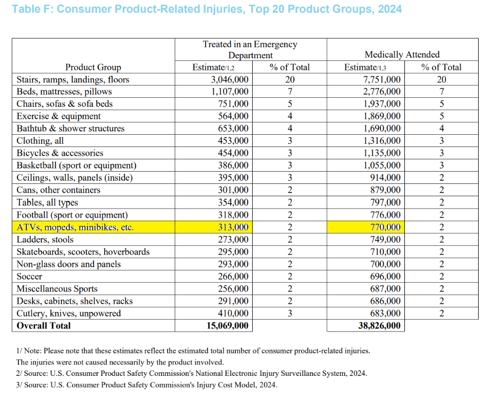
Source: U.S. CPSC, Consumer Product-Related Injuries and Deaths in the United States: Estimated Injuries Occurring in 2024 and Estimated Deaths Occurring in 2023, Table F, page 13.
Another potential source of data is the National Highway Traffic Safety Administration’s (NHTSA) data, but this only covers fatalities on public roads. To address this significant product safety data gap, CFA has collected OHV fatality data from news articles annually since 2013. We make this data available on our website for researchers and advocates.
The Majority of OHV Deaths Are Associated with On-Road Use
According to CFA’s 2025 fatality data, OHV fatalities disproportionately occurred on roads (66%). Even industry groups have opposed the use of OHVs—including All-Terrain Vehicles (ATV) —on public streets, roads, or highways because these vehicles are not designed, manufactured, or intended for this use. Unfortunately, roadway crashes are more likely to involve multiple fatalities, collisions, and head injuries. Victims in roadway crashes are less likely to wear protective gear, such as helmets, and were more likely to be carrying passengers, both things that are risk factors for ATV-related fatalities and injuries.
The National Highway Traffic Safety Administration maintains the Fatality Analysis Reporting System (FARS), a nationwide census of fatal injuries resulting from motor vehicle crashes. In the 1980s, NHTSA began identifying crashes involving all-terrain vehicles (ATVs) on public roads, and in 2017, the agency began identifying crashes involving Recreational Off-Highway Vehicles (ROVs) on public roads. The most recent FARS fatality data, released in 2023, shows that fatalities among minors involving off-highway vehicle (OHV) use on public roads are comparable to fatalities among minor bicyclists. This data underscores the alarming rate of fatalities among minors associated with OHV use.
State-Level Data Demonstrate Permissive On-Road Use Leads to More OHV-Related Fatalities
In 2024, CFA analyzed per-capita OHV fatalities by state from 2013-2024 and discovered a troubling yet predictable pattern: states that allow OHVs on public roads tend to experience a higher number of deaths per capita. West Virginia saw the most per-capita fatalities (15.28 fatalities per 100,000 people), followed by states in the northwestern part of the country (Alaska, Montana, and Wyoming). The data underscored the urgent need for government intervention and increased public awareness in these areas.

Summer Months are Particularly Dangerous
Every year, as temperatures rise and more riders take to trails, dunes, and backcountry roads, OHV fatalities surge dramatically during the peak summer months. Fatalities increased substantially during the peak riding season in 2025, averaging approximately 66 deaths per month from May through September, compared with an average of 36 deaths per month during the rest of the year. July and August experienced the highest number of fatalities, with 84 and 77 deaths, respectively. This predictable spike continues to take lives each summer, turning what should be a season of adventure into one marked by tragedy for too many families.
As fatalities continue to remain high year after year, the CPSC must play a crucial role in enforcing safety standards, conducting research, and implementing regulations designed to protect consumers from preventable accidents. However, recent efforts to eliminate this independent, bipartisan agency and gut its leadership leave consumers more vulnerable to life-threatening accidents. The spike in OHV fatalities highlights the critical need for a strong, functioning CPSC that can continue its life-saving work in the face of these ongoing threats.
CFA has been working to minimize deaths and injuries from OHVs for decades by petitioning the CPSC to ban adult-size ATVs for children, convening a coalition to prevent OHV road access, compiling fatality information in real time with that coalition, and urging the CPSC to collect annual Recreational Off-Highway Vehicle (ROV) data, among other requests to take steps to reduce OHV deaths and injuries.
CFA urges consumers to take the following seven critical steps to reduce OHV deaths and injuries:
-
Never operate an OHV on a road.
-
Never permit children younger than 16 years old to operate an adult-size OHV or any OHV that is too large or too powerful for them.
-
Always wear a helmet and other protective gear when riding an OHV.
-
When riding an OHV with seatbelts, always wear them.
-
Never allow more people on an OHV than it was designed to carry.
-
Never ride when under the influence.
-
Take a hands-on safety course.
Our partners at Prevent Child Injury have issued an important ATV safety toolkit aimed specifically at helping parents learn about the risks of children using ATVs. If consumers have experienced an incident or injury involving an OHV, reports can be submitted to the CPSC. All of the data in the blog is available on our website.
*CFA extends a thank you to our friend Stephen Oesch for assisting CFA in collecting fatality data and analyzing the National Highway Traffic Safety Administration’s Fatality Analysis Reporting System.